Author: kimberlyfayebaker

Posts

Welcome to a world of limitless possibilities, where the journey is as exhilarating as the destination, and where every moment is an opportunity to make your mark.

  • 2026 Temperature Cross Stitch: July (The One Where I Chose a Different Path)

    2026 Temperature Cross Stitch: July (The One Where I Chose a Different Path)

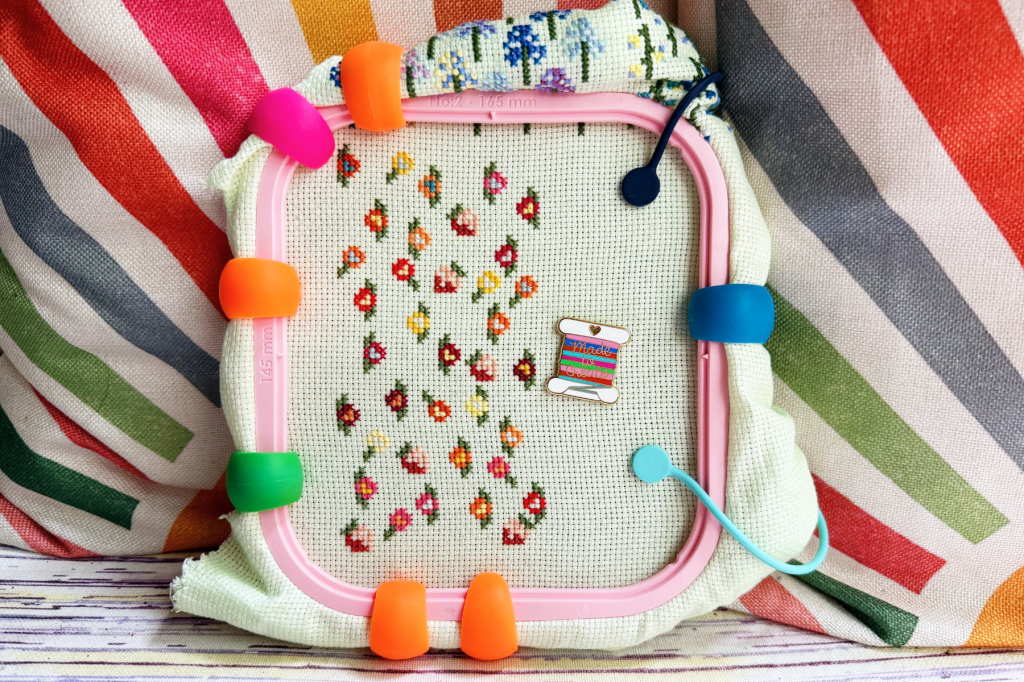
    If you’ve been following this project all year, you may have noticed there was no June update. That’s because somewhere between finishing May and attempting to start June, this project came to an end. Not because I finished it. Because I finally stopped.

    June was my breaking point. More than half the days in the pattern were 101 stitches each, and if I’m being honest, I didn’t even like the month’s motif. I stared at the chart, did a little stitching, stared at it some more, and realized something I probably should have admitted weeks earlier:

    I didn’t want to make this anymore.

    That’s a surprisingly hard thing to admit after spending six and a half months and 4,693 stitches on a project.

    For months, I kept telling myself I’d turn a corner. That I’d eventually enjoy stitching it as much as I enjoyed looking at it. That once I caught up, everything would click. It never did.

    The project was beautiful. I still think it’s a lovely design. But for me, it was too dense, too fussy, and too demanding. I spent more time changing thread colors than actually stitching, and all of those little details made it difficult to appreciate what I was looking at when each month was finished.

    Then I remembered a free temperature pattern from Caterpillar Cross Stitch that I’d admired before. It couldn’t have been more different.

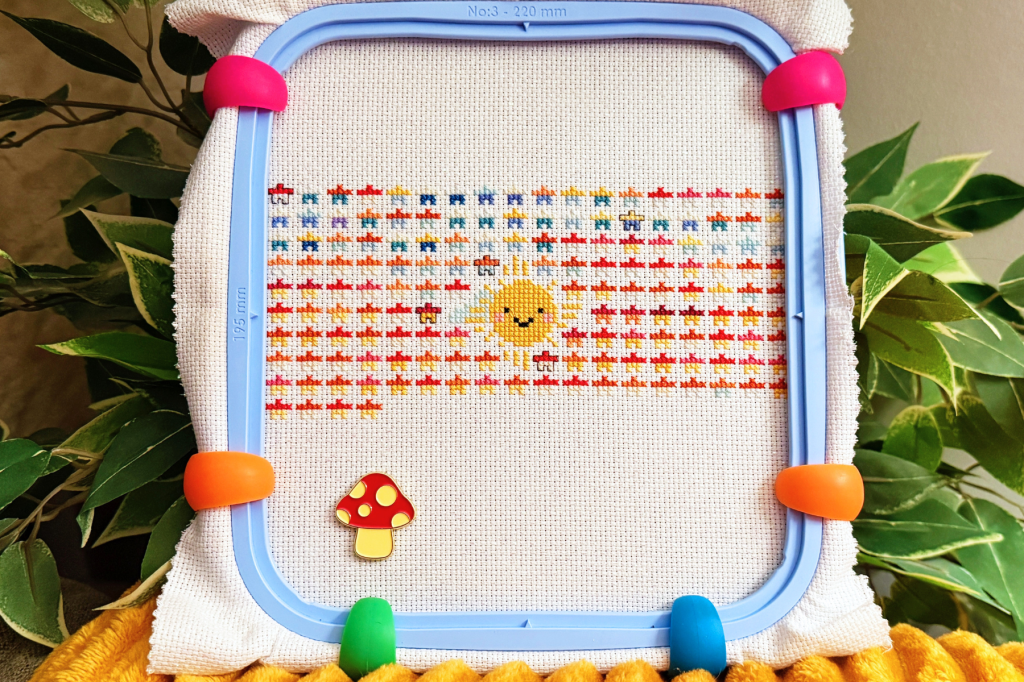
    Simple. Cheerful. Colorful. Instead of tiny motifs scattered across a garden, it creates a row of smiling suns and bright stars that lets you see the changing temperatures at a glance. Even better, I realized I could adapt it to track both the daily high and low temperatures while keeping the color palette I’d refined for the garden. The colors were always my favorite part of the original project, so getting to carry them forward felt like bringing along the best part of the experience.

    Then I did the math. It would literally take fewer stitches to complete January through July in the new project than it would have taken me just to catch up on June in the garden.

    That was the moment everything clicked.

    Why was I forcing myself through a hobby that I wasn’t enjoying when another project existed that made me genuinely excited to stitch? So I switched. And almost immediately, stitching became fun again.

    Instead of feeling guilty every time I picked up my hoop, I found myself looking forward to it. The new project makes me smile. It’s simple without feeling boring, colorful without feeling overwhelming, and it actually does what I wanted a temperature project to do in the first place: show the story of the weather in a way that’s easy to understand with one quick glance.

    It reminded me that hobbies aren’t supposed to feel like obligations. Sometimes it’s okay to quit. Or maybe “quit” isn’t the right word. Sometimes it’s okay to choose peace over sunk costs. To acknowledge that you’ve learned what you needed to learn, thank a project for the lessons it taught you, and move on to something that brings you joy instead.

    The garden taught me that. The stars are reminding me why I started stitching in the first place.

    By the Numbers

    ⬆️ High: 104.2°F (July 4)
    ⬇️ Low: 61.0°F (July 24)
    🌡️ Biggest swing: 30.6°F (July 4)

    As of this update, I’ve already caught up through May, June, and July on the new project. There are still a few months left to fill in, but for the first time in a long time, catching up feels exciting instead of impossible.

    Now I just have one decision left to make.

    What do I do with a half-finished garden that contains 4,693 stitches and will never be completed?

    Right now, I’m leaning toward embracing the story. Maybe I’ll fill the empty space with a snarky quote about quitting, choosing peace, or protecting your mental health, frame it anyway, and let it be a reminder that there are no rules in crafting—or in life. Not every project has to be finished to be worthwhile.

    Sometimes the happiest ending isn’t finishing.

    Sometimes it’s knowing when to stop.

  • 2026 Temperature Cross Stitch: May

    2026 Temperature Cross Stitch: May

    Remember last month when I confessed that I actively detest this project?

    Good news: nothing has changed.

    Actually, that’s not entirely true. I still hate stitching it, but I’ve finally accepted that this is just the relationship we’re going to have for the next seven months.

    The irony is that the finished piece becomes more beautiful every month. I can see the vision now. The garden is really starting to take shape, and I genuinely love looking at the progress. I just don’t particularly enjoy making it.

    May’s weather certainly didn’t make things boring. The highest temperature reached 100.8º, while the lowest dipped to 40.8º. The biggest swing came on May 16, when temperatures jumped 39.6º over the course of the day.

    The garden reflects all of it. Cool blues gave way to warmer shades of yellow, orange, pink, and deep red. It feels like the garden fully embraced late spring, even if Mother Nature couldn’t quite make up her mind.

    The biggest lesson for May wasn’t really about stitching at all. It’s that once I fall behind on this project, it becomes exponentially harder to convince myself to pick it back up. Every missed day turns into another four colors to change, another section to count, another reminder that I’m behind. It’s a terrible cycle because the more I avoid it, the bigger the mountain becomes.

    The only way through is… through. So I stitched. One day. Then another. Then another. Before I knew it, May was finished.

    I’m still not a fan of the fabric. I’m still not thrilled about changing thread colors every few stitches. I still think tracking both high and low temperatures was an ambitious choice.

    I also have to admit that seeing five months together changes my perspective a bit. Looking at each month individually, all I notice are the mistakes, the thread changes, and the days that felt like chores. Looking at them together, I see a garden that’s slowly coming to life.

    Speaking of mistakes… yes, I know they’re there. Trust me, I’ve found every single one of them. I frogged parts of May twice before finally deciding I’d reached the point of diminishing returns. At this stage, “done is beautiful.” Unless a mistake is glaringly obvious, it’s staying exactly where it is. This project has already demanded enough of my time and patience, and I simply couldn’t be bothered to chase perfection anymore.

    Maybe that’s the lesson for May. Sometimes good enough really is good enough.

    No, I don’t suddenly love this project. But I do love seeing what it’s becoming. And that’s enough motivation to keep going.

    Here’s hoping June and I can come to some sort of understanding.

  • 2026 Temperature Cross Stitch: April

    2026 Temperature Cross Stitch: April

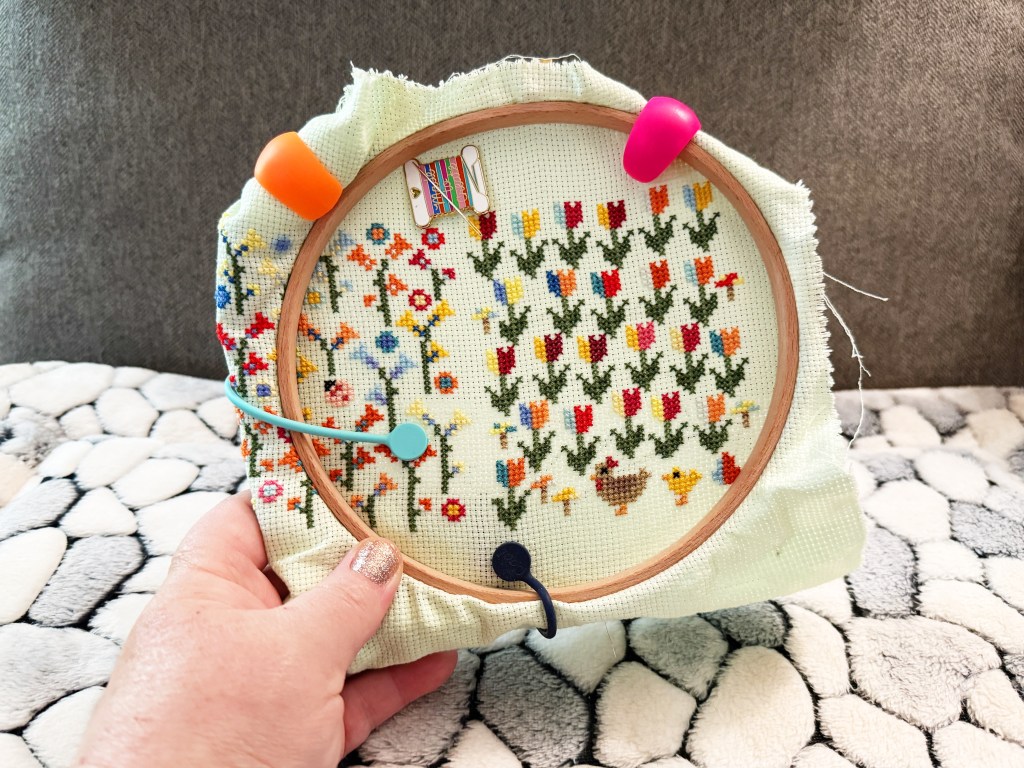
    I’ve now finished stitching four months of this project, and I think it’s finally time to admit something: I kind of hate it.

    Scratch that. Not “kind of.” I actively detest it at this point.

    Not the finished product, necessarily. I still think the completed garden will be beautiful someday. But the actual experience of stitching it? That’s another story.

    I hate the fabric. It’s loose and slippery, and I swear I can feel it stretching as I stitch. More than once, I’ve used a hole that wasn’t really a hole and had to frog my work before starting over.

    I hate how many colors are involved because I’m constantly switching threads. What do you mean I’m using up to FOUR different colors per day?

    I hate how dense each day feels. Instead of being relaxing, stitching often feels like a chore I’m trying to power through before bed.

    And honestly? I hate that I let myself fall so far behind, because now every stitching session feels less like creativity and more like trying to pay off a debt.

    April’s temperatures ranged from 30.9º to 95.2º, with a 48.4º swing on April 10 alone. (I’m sure that was some crazy weather day, but unfortunately it’s so long ago that I have no recollection.) Which, honestly, feels fitting for a project that increasingly seems determined to keep me emotionally unstable through the medium of embroidery floss.

    I kept waiting for this project to click the way last year’s cat temperature project did. I thought eventually I’d settle into a rhythm and finally start loving it.

    Four months in, I’m starting to worry that moment may never come.

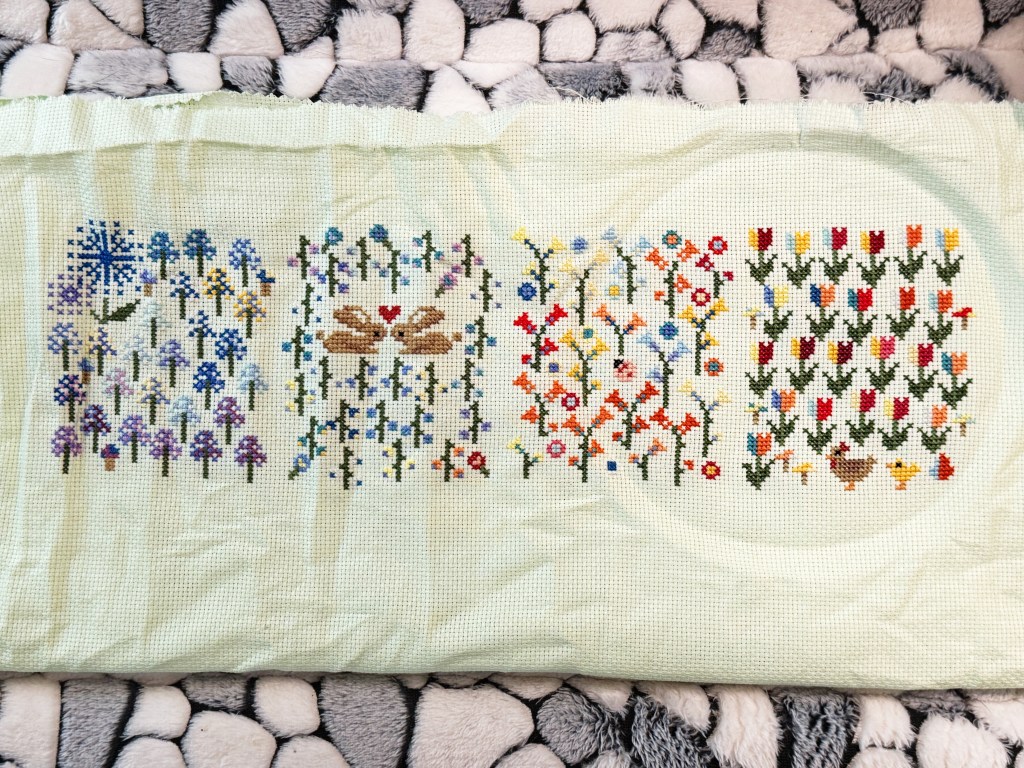
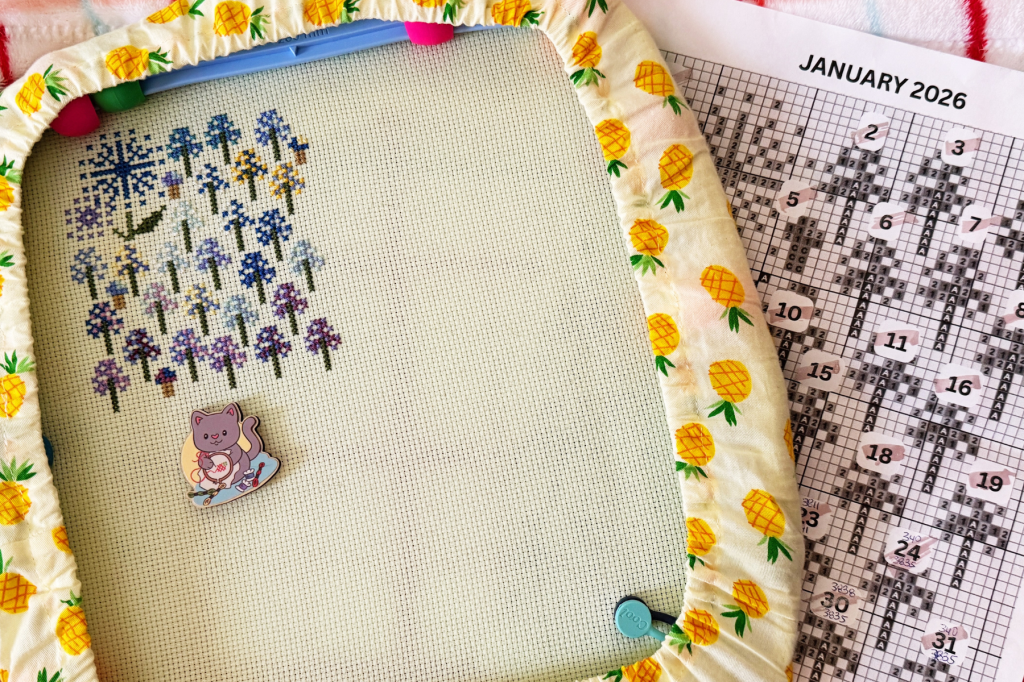
    Here’s a look at four months of stitching progress. Or, depending on your perspective, four months of frustration preserved in embroidery floss.

    You’ll notice I didn’t even bother ironing it before taking photos. That should tell you everything you need to know about where I’m at emotionally with this project right now.

    But getting there has felt exhausting.

    I think part of the problem is that this project demands constant attention. Last year’s project felt simple and meditative. This one feels fussy. Every section requires counting, thread changes, or double-checking charts and spreadsheets. Instead of helping me unwind, it sometimes leaves me more mentally tired than when I started.

    And yet… I’m still stitching it.

    Partly because I’ve already invested so much time into rebuilding charts and organizing spreadsheets around it. Partly because I genuinely want to see the finished garden come to life.

    And partly because, according to Markup R-XP, I’ve already stitched 3,977 stitches this year. At this point, sheer stubbornness may be carrying the project more than inspiration.

    But mostly because I think this project might be teaching me something important about the difference between loving an idea and loving the process.

  • A Little Magic, Right When I Needed It

    A Little Magic, Right When I Needed It

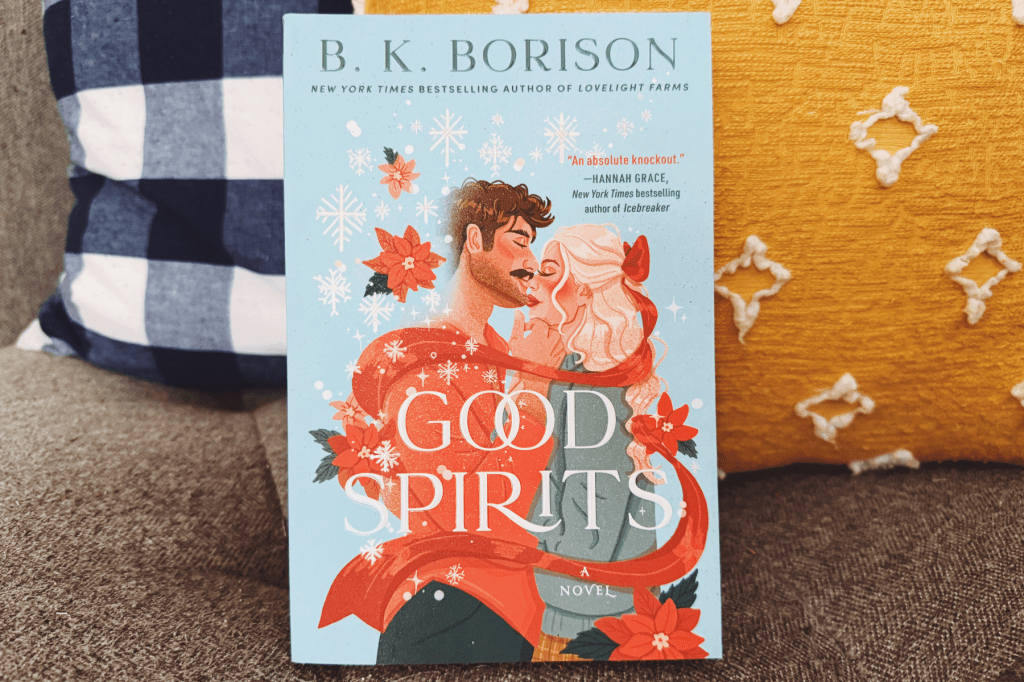
    Oh hey, while we’re on the subject of overdue March updates… I finally read a book. Well, finished a book, anyway.

    I started Good Spirits back near Christmas and fell in love with it almost immediately. B.K. Borison has a real knack for writing stories that feel soft and whimsical in the best way, full of warmth and characters you just want to spend time with. Add in a sparkling Christmas setting and (more than) a little magic, and it’s basically a book with my name written all over it.

    I was chugging right along, grinning and swooning my way through the story. Then life happened. Things got busy. Suddenly, my bedtime ritual of reading a couple of chapters each night disappeared because I was falling asleep the second my head hit the pillow. Between work, holiday prep, craft shows, my Etsy shop, and everything else, I set the book back on my nightstand and told myself I’d get back to it soon.

    “Soon” turned into March.

    But picking it back up felt like stepping right back into that same cozy little world, and it was every bit as wonderful as I remembered. Magic, whimsy, a lot of heart, and exactly the kind of story I needed, even if it took me a few extra months to get there.

    I’m not planning to write a full review (at least not right now), but I wanted to share how much I enjoyed this lovely book. It hit all the emotions, gave me exactly the right amount of whimsy and holiday magic, and even made me shed a few tears. I’m very much looking forward to the second book, Grim Tidings, this fall. (Another A+ title, honestly.)

    It’s a little weird to go from reading hundreds of books in a year to maybe finishing in the very low double digits, but life changes. Good Spirits reminded me just how much I love getting lost in a good book. I should do it more often.

  • 2026 Temperature Cross Stitch: March

    2026 Temperature Cross Stitch: March

    I’m (more than) a little overdue on this one, but March’s garden is finally finished and ready to share.

    March’s temperatures ranged from 25.2º to 91.4º in Burke. Yes, you read that right. March. The biggest swing came on March 12, with a 46.8º shift in a single day. And honestly, that tracks.

    It was 90º on March 11 and still warm when I left for the office the next morning. By midmorning, we had torrential downpours, strong winds, and occasional hail. Shortly after noon, it started snowing. A few hours later, every bit of snow that had stuck to the trees, grass, and cars was gone. It was one of the wildest 24-hour stretches of weather I’ve ever experienced.

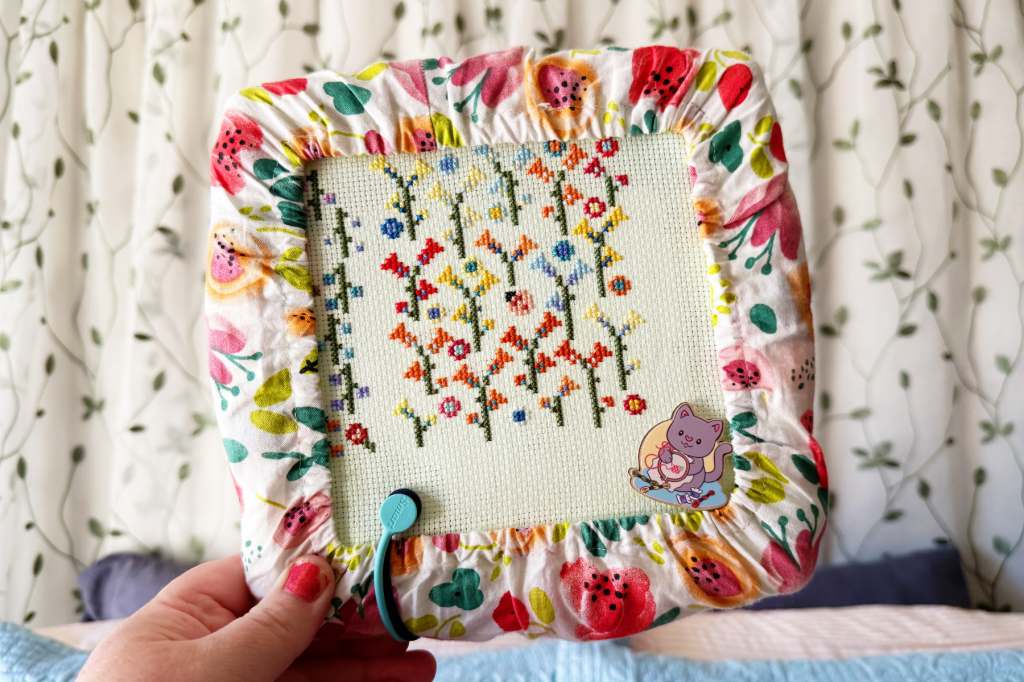
    Visually, that chaos shows up in the stitching. There’s far more orange and red than I ever expected to see in March, especially with a good amount of purple and blue still mixed in. It’s a strange palette for early spring, but also a very accurate reflection of the month.

    This month’s flowers tested me in just about every way possible. It’s a good thing no one except me knows exactly how the pattern is supposed to look, because I definitely took a few liberties along the way. Let’s call them “creative adjustments.”

    That said, I do love the little ladybug and the wide range of colors that came out of it. Even when it felt chaotic, it still came together into something I enjoy looking at.

    And I am very much looking forward to April, which promises a far more straightforward pattern and an abundance of tulips.

    My biggest lesson this month was simple. No matter how frustrated I get, I need to try very hard not to fall behind. Once I do, catching up becomes a truly herculean task.

  • 2026 Temperature Cross Stitch: February

    2026 Temperature Cross Stitch: February

    February kept things interesting. The weather was completely unpredictable. Great for creating color variety in a temperature project. Not so great for planning (anything) or commuting.

    The high reached 68.4º, while the low dipped to 11.7º, giving the garden another wide spread of color to work with. The biggest temperature swing happened on February 14, when we jumped from 21º to 59.7º. A 38.7º swing in a single day feels dramatic, even for February.

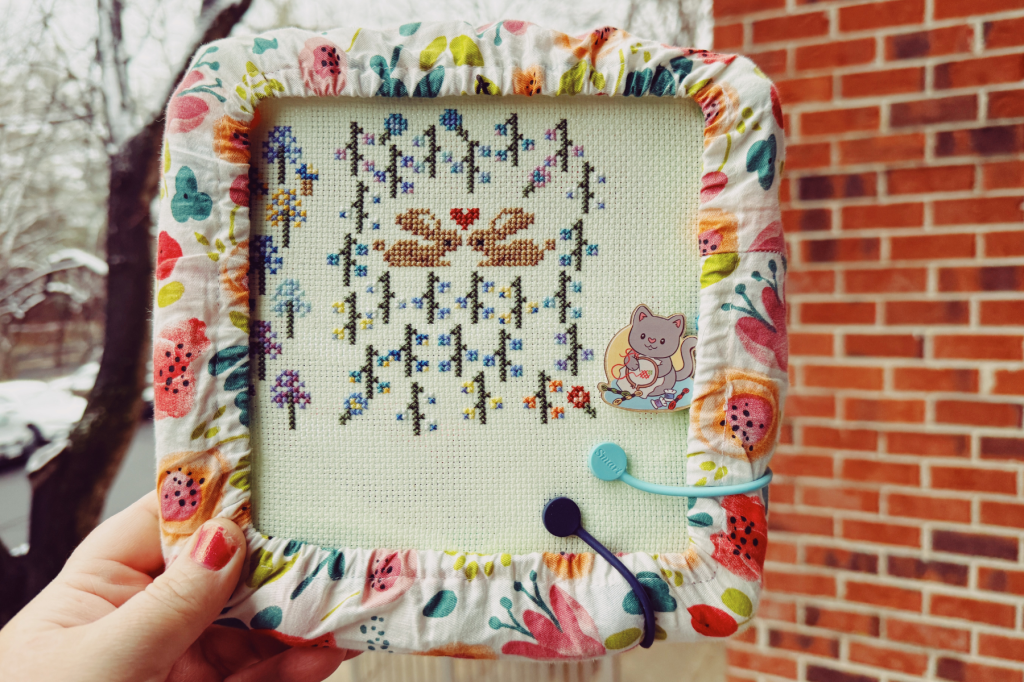
    February didn’t just bring new temperatures. It introduced two new types of flowers to the garden, along with an array of fresh colors that brightened the whole scene. And a pair of very cute bunnies for an added touch of whimsy.

    You might recall I mentioned in my January launch post that I suspected I would learn additional lessons along the way. I was right.

    I started the year using a large hoop so I could see more of the project at once. In theory, it felt efficient. In reality, it was unwieldy and mildly infuriating. I was fighting the hoop as much as I was stitching the pattern.

    Before I began February, I downsized to a smaller hoop. What a difference it has made. Instead of wrestling with the hoop and dreading the process, I feel more focused and far less overwhelmed. My stitching has improved, and so has my attitude. Significantly.

    It turns out I work better on smaller surfaces. Large, unwieldy hoops and I simply do not get along.

    Another lesson learned. Another small adjustment that makes this project so much more enjoyable.

  • 2026 Temperature Project: A Cozy Garden (and a Chaotic January Catch-Up)

    2026 Temperature Project: A Cozy Garden (and a Chaotic January Catch-Up)

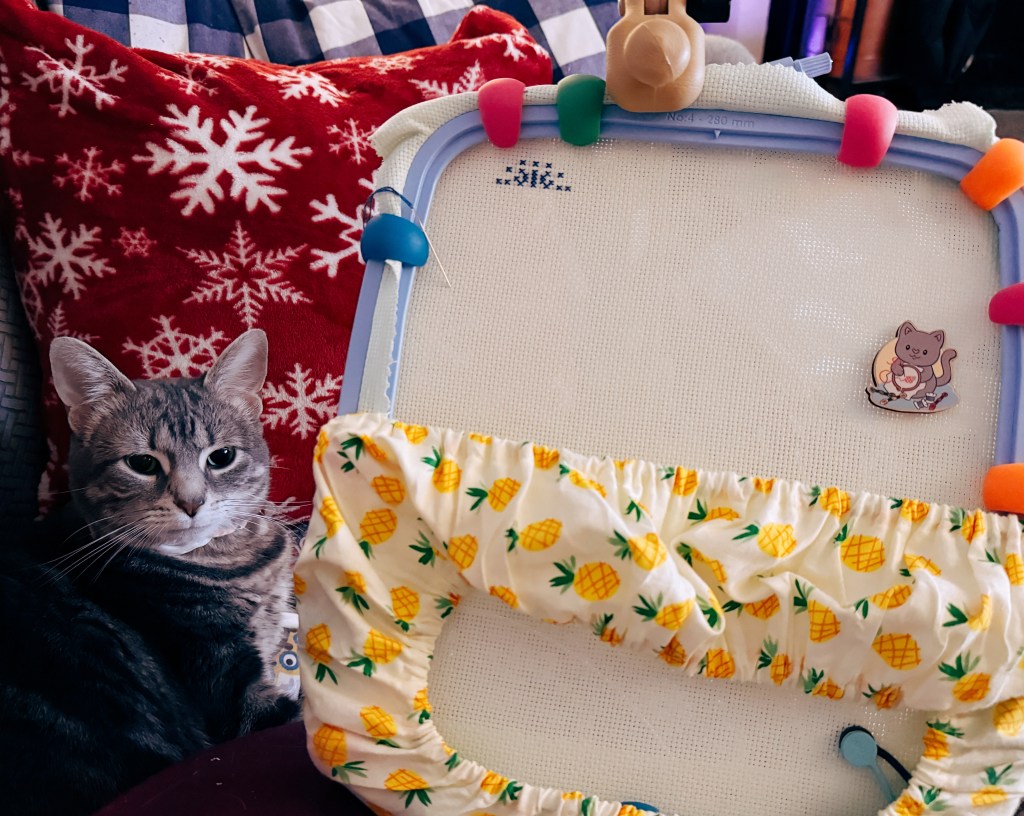
    This year, we’ve officially left the cats behind. Well, the cross stitched ones, anyway. Muffin still insists on being involved, or at the very least adjacent to, all of my projects. She may not be the focus of this one, but she is absolutely part of the process.

    For 2026, I’m stitching a cozy garden — complete with a charming cottage and a few adorable critters — with tiny patches of flowers and plants that change with the months. Each day adds to the landscape. Each temperature shifts the colors. By December, the whole little world should feel alive.

    And honestly? It almost didn’t happen.

    The Struggle to Start

    I knew this project was ambitious. It’s large. It’s detailed. It’s whimsical. It’s exactly what I wanted for the year. Never mind that I bought two other patterns before finally landing on this one. Indecision is apparently also the theme of 2026.

    What I didn’t fully account for, though, was how much front-end work this would require.

    The pattern itself is lovely. Truly. But for my brain? It wasn’t quite detailed enough in the places where I needed clarity. Which plant goes with which day? What do you mean I can just decide whether the squares marked 1 or 2 represent the high or the low temperature? I need more structure than that. Instead of diving in, I stalled.

    Eventually, I did what I always do when a pattern doesn’t work exactly the way I want it to: I rebuilt it. I recreated the entire thing in MacStitch so I could see it the way my brain needed to see it. I mapped out each plant. I clarified the layout. And because I clearly enjoy making things harder for myself, I also created cheat sheet PDFs for every single month so I know exactly which flower or plant gets stitched each day.

    And then, because apparently we were committing fully to the bit, I built a Google Sheet. Now I enter the daily high and low temperatures, and it tells me exactly which DMC thread colors to use. No second-guessing. No flipping back and forth between charts. Just tidy, color-coded certainty.

    Last year’s temperature project was fully analog. Paper charts. Manual tracking. Vibes. This year? I have spreadsheets.

    Was all of this necessary? Debatable. Did it give me peace? Absolutely.

    There’s something about a temperature project that feels deceptively simple. “Just stitch the daily color.” Except this one isn’t just color blocks. It’s landscaping. It’s garden planning. It’s high and low temperatures layered into petals and plants. It’s an entire ecosystem supported, apparently, by a small but mighty data management system.

    I may have slightly bitten off more than I could chew at the start. Once the foundation was set, I was excited to stitch. Then I spent half of January racing to catch up, which almost undid all that excitement.

    January Update

    January’s temperatures in Burke ranged from 7.3º to 64.6º. Quite the range, right? The biggest single-day swing happened on January 21, when we jumped from 13.3º to 45.7º.

    That made for a surprisingly dynamic color spread right out of the gate. Most of the palette stayed in cool purples and blues, but those warmer days added little pops of yellow that brighten the garden in unexpected ways.

    Because I’m tracking both highs and lows this year, each day brings double the data and double the stitching. Most days leaned icy and muted. Others surprised me with small hints of warmth that feel like early whispers of spring.

    Sticking With It

    I know this project is going to be beautiful when it’s finished. I adore the palette. I love the cozy, whimsical vibe. I can already picture it framed and hanging somewhere it can catch the light.

    But this year is teaching me something different than the cat project did. This one isn’t just about showing up daily. It’s about building structure first. It’s about problem-solving. It’s about giving myself permission to adjust the pattern so it works for me.

    And maybe that’s the real January lesson.

    I have a feeling there will be other lessons along the way, too. This project is big enough and detailed enough that I’m sure it will challenge me again. When it does, I’ll share that part, too.

    We’re caught up. The cheat sheets are printed. The MacStitch file is organized. The Google Sheet is doing the heavy lifting. The garden has officially begun.

    Now we just have to keep it growing. 🌿

  • An Epic January Declutter

    An Epic January Declutter

    January always puts me in a reset the vibes kind of mood. New year, fresh start, let’s clean out some chaos. But instead of tackling one giant, overwhelming declutter project, I decided to gamify it.

    Enter: a spinning wheel.

    I found an iPhone app that lets you create customized spinning wheels and I thought that would be fun to use. Every day in January, I spin the wheel. Whatever number it lands on is how many items I have to get rid of that day. Once a number is used, it’s removed from the wheel. No repeats. No bargaining. Just spin, declutter, repeat.

    By the end of the month, I’ll have tossed, donated, or passed along 496 items.
    (Yes, I did the math. No, I did not want to see that number before starting.)

    What Am I Getting Rid Of?

    This isn’t a full Marie Kondo, “touch every object you own and thank it” situation. This is a practical, realistic declutter focused on the places that quietly collect clutter without us noticing.

    I’m zeroing in on:

    • Cabinets, closets, and drawers
    • Old nail polish and expired cosmetics
    • Clothes I don’t wear (and realistically won’t again)
    • Books I’m never going to read, or ones I don’t need to keep on my shelves anymore

    That said, I am taking joy into consideration. If something earns its space and still makes me happy, it stays. The goal isn’t emptiness. It’s breathing room.

    Trash, Donate, Repeat

    Yes, some of this stuff is getting thrown away. Old cosmetics and dried-up nail polish have reached the end of the road, and that’s okay.

    But a surprising amount of it is finding new homes instead. I’m passing along usable items through my local Buy Nothing group and donating what makes sense to a local organization.

    Books are getting a special treatment in this declutter. Any titles I’m ready to let go of are being donated to the library, where they can find new readers and help support the library’s all-important programming through book sales. Libraries give so much to a community—resources, space, access, and connection—and this feels like a small, tangible way I can give something back while clearing my shelves.

    Clearing space for myself feels even better when I know those things might be useful, loved, or helpful somewhere else.

    Why This Is Working (So Far)

    The spinning wheel is doing a lot of heavy lifting here. Some days it’s merciful. Some days it chooses chaos. But because the number is random and non-negotiable, I don’t overthink it. I just do it.

    A little every day feels manageable. Even the big numbers get easier once you realize how much low-effort clutter exists in your life.

    January isn’t about becoming a new person. It’s about making space for the one you already are. And right now, that starts with 496 fewer things.

    At the end of the month, I’m planning to do a full declutter wrap-up to share how this actually went—what worked, what surprised me, and whether the spinning wheel was a brilliant idea or pure chaos. Mostly, though, it’s a way to keep myself accountable. If I say it out loud (and on the internet), I’m much more likely to follow through. So stay tuned for the final tally, a few lessons learned, and proof that January really did leave me with a little more space to breathe.

  • 2025 Temperature Cross Stitch: December

    2025 Temperature Cross Stitch: December

    And just like that, my 2025 temperature cross stitch project is complete. What started as a “sure, why not?” idea at the very beginning of my cross stitch journey turned into one of my favorite creative projects of the year. Over the course of 365 days, 2,250 stitches, 30 colors, and 12 little cats, I stitched the average daily temperature in Burke, VA for all of 2025. Seeing the entire year come together at the end feels incredibly satisfying. Just look at these colorful little cats!

    Looking back, there are a few big lessons I’m taking with me from this project.

    First, fabric really matters. I chose a Fiddler’s Cloth from Michael’s because I wanted to avoid white fabric, knowing this piece would be handled daily for an entire year. Unfortunately, that choice did not age well. The Loops & Threads brand was rough, inconsistent, and honestly kind of trash. Do not recommend.

    Second, my stitching improved so much over the course of the year. When I started this project, I had been cross stitching for less than a month. Watching my tension improve, my stitches get cleaner, and my confidence grow as I learned better ways to start and finish threads was one of the most rewarding parts of the process. You can literally see that progress stitched into the piece, especially when you look at the first cat next to the last.

    Another big takeaway is how important it is to keep up with a project like this regularly. When life got chaotic toward the end of the year, this project slipped to the back burner, and I ended up stitching almost all of December at the same time. It turns out this is far more fun when you’re doing a little bit each day, or at least every couple of days. The daily rhythm is part of what makes a temperature project special, and I definitely felt the difference when that routine disappeared.

    I’m so glad I decided to use a Q-Snap frame for this project. Being able to mix and match pieces to fit the slightly odd fabric size meant I could see almost the entire piece at once, which made a huge difference over the course of the year. Pairing it with a grime guard also helped keep the fabric clean through months of regular handling.

    I also loved how simple and analog this year’s pattern was. Tracking temperatures with pen and paper felt refreshing in a world where everything is digital. There was something deeply satisfying about writing down the daily average temperature and physically marking my progress as I went.

    That said, I’m already switching things up for next year. The 2026 pattern is more complicated, and I’ll be tracking everything digitally this time. It feels like the right evolution after finishing a project of this scale. More on that very soon.

    This temperature cross stitch will always be special to me. It represents an entire year of learning, patience, and showing up creatively, one tiny stitch at a time. Now I need to decide how I want to frame or mount it and give it a spot on my wall.