

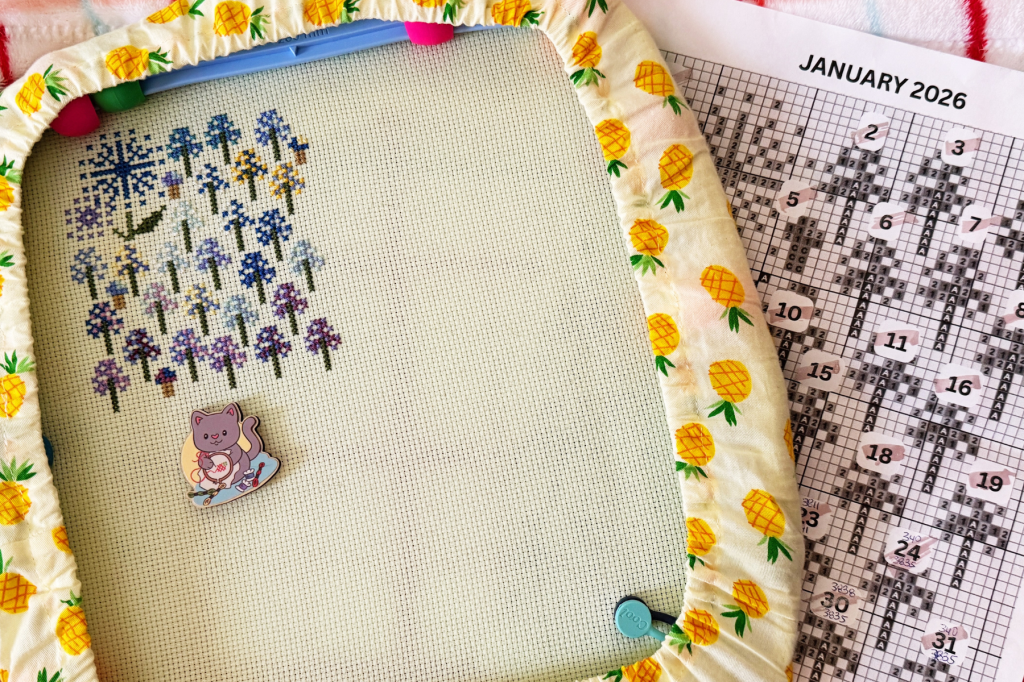
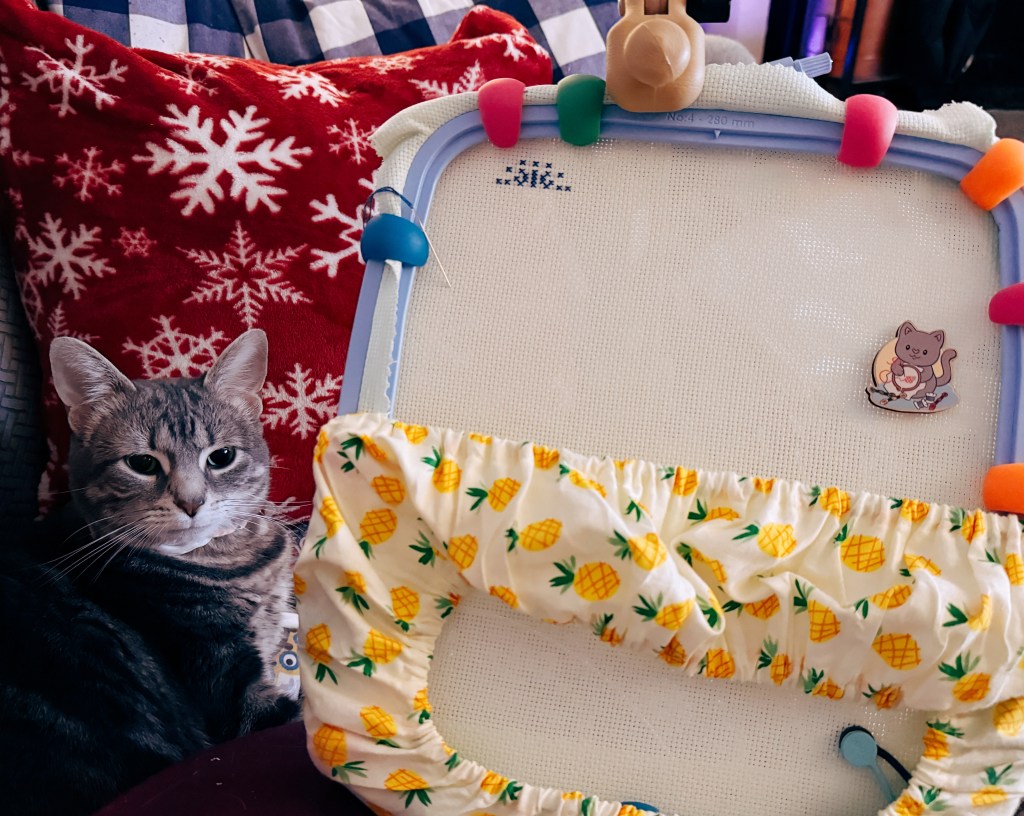
This year, we’ve officially left the cats behind. Well, the cross stitched ones, anyway. Muffin still insists on being involved, or at the very least adjacent to, all of my projects. She may not be the focus of this one, but she is absolutely part of the process.
For 2026, I’m stitching a cozy garden — complete with a charming cottage and a few adorable critters — with tiny patches of flowers and plants that change with the months. Each day adds to the landscape. Each temperature shifts the colors. By December, the whole little world should feel alive.
And honestly? It almost didn’t happen.
The Struggle to Start
I knew this project was ambitious. It’s large. It’s detailed. It’s whimsical. It’s exactly what I wanted for the year. Never mind that I bought two other patterns before finally landing on this one. Indecision is apparently also the theme of 2026.
What I didn’t fully account for, though, was how much front-end work this would require.
The pattern itself is lovely. Truly. But for my brain? It wasn’t quite detailed enough in the places where I needed clarity. Which plant goes with which day? What do you mean I can just decide whether the squares marked 1 or 2 represent the high or the low temperature? I need more structure than that. Instead of diving in, I stalled.
Eventually, I did what I always do when a pattern doesn’t work exactly the way I want it to: I rebuilt it. I recreated the entire thing in MacStitch so I could see it the way my brain needed to see it. I mapped out each plant. I clarified the layout. And because I clearly enjoy making things harder for myself, I also created cheat sheet PDFs for every single month so I know exactly which flower or plant gets stitched each day.
And then, because apparently we were committing fully to the bit, I built a Google Sheet. Now I enter the daily high and low temperatures, and it tells me exactly which DMC thread colors to use. No second-guessing. No flipping back and forth between charts. Just tidy, color-coded certainty.
Last year’s temperature project was fully analog. Paper charts. Manual tracking. Vibes. This year? I have spreadsheets.
Was all of this necessary? Debatable. Did it give me peace? Absolutely.
There’s something about a temperature project that feels deceptively simple. “Just stitch the daily color.” Except this one isn’t just color blocks. It’s landscaping. It’s garden planning. It’s high and low temperatures layered into petals and plants. It’s an entire ecosystem supported, apparently, by a small but mighty data management system.
I may have slightly bitten off more than I could chew at the start. Once the foundation was set, I was excited to stitch. Then I spent half of January racing to catch up, which almost undid all that excitement.
January Update
January’s temperatures in Burke ranged from 7.3º to 64.6º. Quite the range, right? The biggest single-day swing happened on January 21, when we jumped from 13.3º to 45.7º.
That made for a surprisingly dynamic color spread right out of the gate. Most of the palette stayed in cool purples and blues, but those warmer days added little pops of yellow that brighten the garden in unexpected ways.
Because I’m tracking both highs and lows this year, each day brings double the data and double the stitching. Most days leaned icy and muted. Others surprised me with small hints of warmth that feel like early whispers of spring.
Sticking With It
I know this project is going to be beautiful when it’s finished. I adore the palette. I love the cozy, whimsical vibe. I can already picture it framed and hanging somewhere it can catch the light.
But this year is teaching me something different than the cat project did. This one isn’t just about showing up daily. It’s about building structure first. It’s about problem-solving. It’s about giving myself permission to adjust the pattern so it works for me.
And maybe that’s the real January lesson.
I have a feeling there will be other lessons along the way, too. This project is big enough and detailed enough that I’m sure it will challenge me again. When it does, I’ll share that part, too.
We’re caught up. The cheat sheets are printed. The MacStitch file is organized. The Google Sheet is doing the heavy lifting. The garden has officially begun.
Now we just have to keep it growing. 🌿

 KimberlyFaye Blogs
Leave a comment